



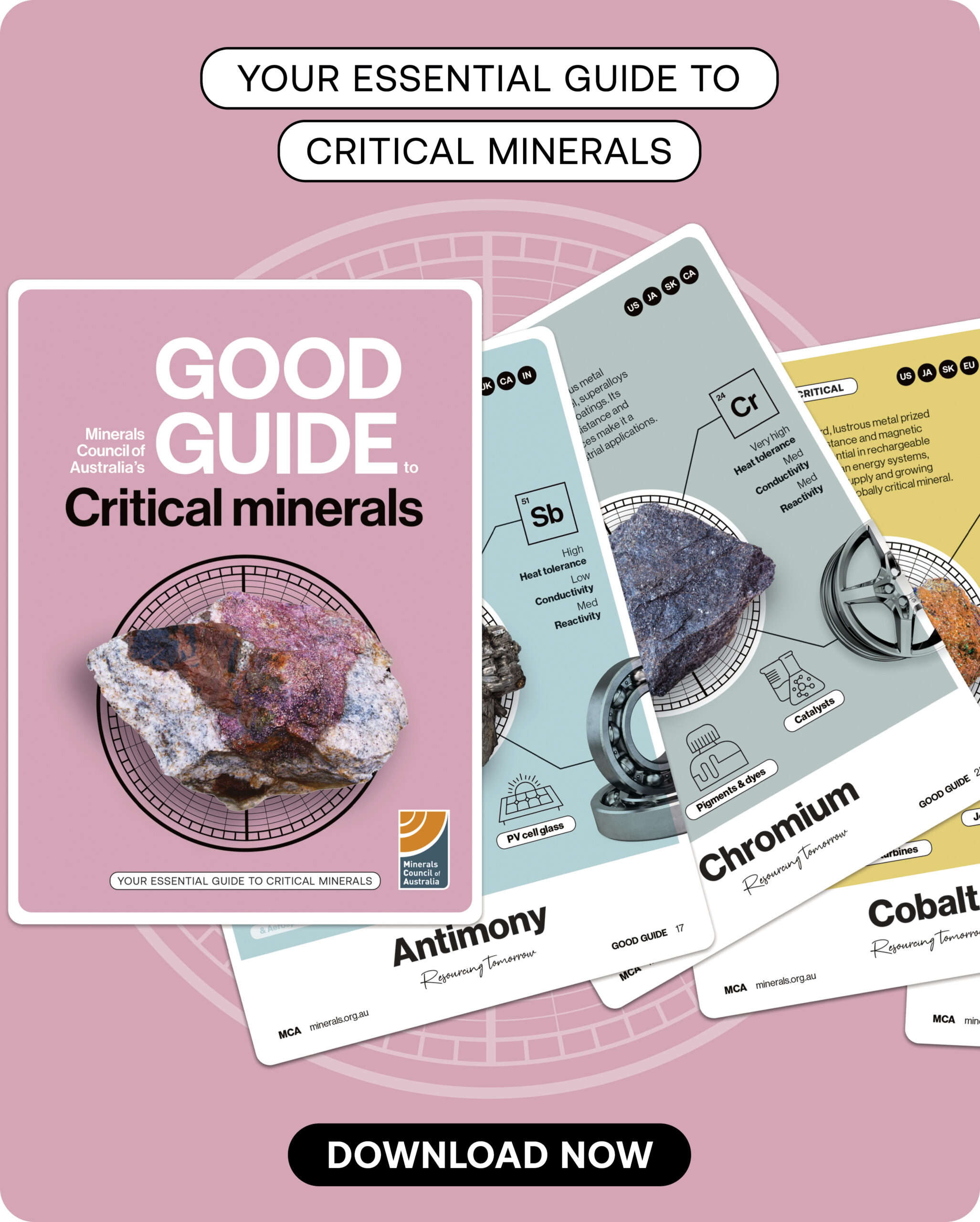
 Good Guide to Critical Minerals
Competitive advantage
Australia’s rich geology, mining expertise and growing processing capability position the nation to become an increasingly important secure global supplier.
Critical minerals are the building blocks of technologies, industries and national capabilities that will shape the decades ahead.
They are used in electric vehicles and batteries, renewable energy and electricity networks, defence equipment and aerospace, semiconductors and digital infrastructure, advanced manufacturing, healthcare and space technologies.
Their importance is not simply about scarcity.
Governments assess criticality based on factors including import dependence, market concentration, processing bottlenecks and the potential economic or national security consequences of supply disruptions.
Australia’s Critical Minerals List includes minerals such as lithium, cobalt, graphite, gallium, germanium, nickel, tungsten, vanadium and rare earth elements.
Copper, aluminium, phosphorus, tin and zinc are separately designated as strategic materials because of their importance to the energy transition, defence capabilities and advanced technologies.
Why critical minerals matter
The importance of critical minerals stretches far beyond renewable energy and electric vehicles. They also underpin defence and aerospace systems, space exploration, digital infrastructure, advanced manufacturing and healthcare as well as batteries and electricity infrastructure.
Rare earth elements including neodymium and praseodymium are important for powerful permanent magnets. Lithium, graphite and other minerals are used in batteries. Gallium and germanium are necessary for semiconductors and advanced electronics. Tungsten has important industrial and defence applications.
Some critical minerals are also recovered as by-products of processing major commodities including gold, zinc, copper, lead, nickel, bauxite and alumina.
The supply chain challenge
The critical minerals challenge is not just about where minerals are found and mined.
Supply chains extend from exploration and mining through processing and refining to manufacturing.
Even where mineral resources are geographically diverse, processing and refining can be highly concentrated, creating potential bottlenecks and exposing economies to price and physical supply disruptions arising from geopolitical events, trade restrictions or infrastructure constraints.
Diversifying these supply chains has therefore become an economic and national security priority for governments and industries around the world.
Australia’s strategic advantage
Australia is exceptionally well positioned as a secure and reliable supplier.
Our rich geology combined with an established mining industry, skilled workers, high labour and environmental standards, sophisticated supply chains and a longstanding reputation as a stable and reliable supplier to international partners.
Australia is already a global leader in a number of critical minerals and has significant potential to expand both mining and processing.
The opportunity is not confined to extracting minerals from the ground. Australia can capture more value through processing and refining, while helping our international partners develop more diverse and secure supply chains.
Turning potential into production
Australia’s geology gives us an advantage. It does not guarantee success.
International competition for critical minerals investment is intensifying. Australia needs to turn prospective resources into discoveries, discoveries into mines and mines into reliable supply chains.
That requires policies that encourage exploration, improve productivity, support domestic processing and create a more predictable investment environment.
Faster project approvals can strengthen investor confidence, while better geological data can help bring new discoveries to life. International partnerships can also support investment and create more diversified and secure global supply chains.
Australia has what the world needs.
With the right investment and policy settings, our critical minerals can support new Australian industries, strengthen national security, deepen relationships with strategic partners and create long-term economic opportunities for Australians.
Good Guide to Critical Minerals